


Liquid Supplements for Heart Health: A Complete Guide

Nearly 120 million U.S. adults have hypertension, and supplements may offer nutritional support, but they aren’t a stand-alone way to protect heart health. Liquid supplements for heart health support vary by ingredient, and their potential benefits depend on what they contain and your needs.
It makes sense to look for practical ways to care for your heart. The challenge is separating evidence-based nutrient support from product marketing. This guide explains what is known about magnesium, blood pressure, and heart function, and how to assess products without assuming that “heart health” on a label proves results.
You’ll also learn why supplement safety matters, what to discuss with a healthcare provider, and how liquid formulas can fit into a broader approach to wellness. Clear information can help you make a more confident, informed choice.
Table of Contents
Magnesium, blood pressure, and heart function
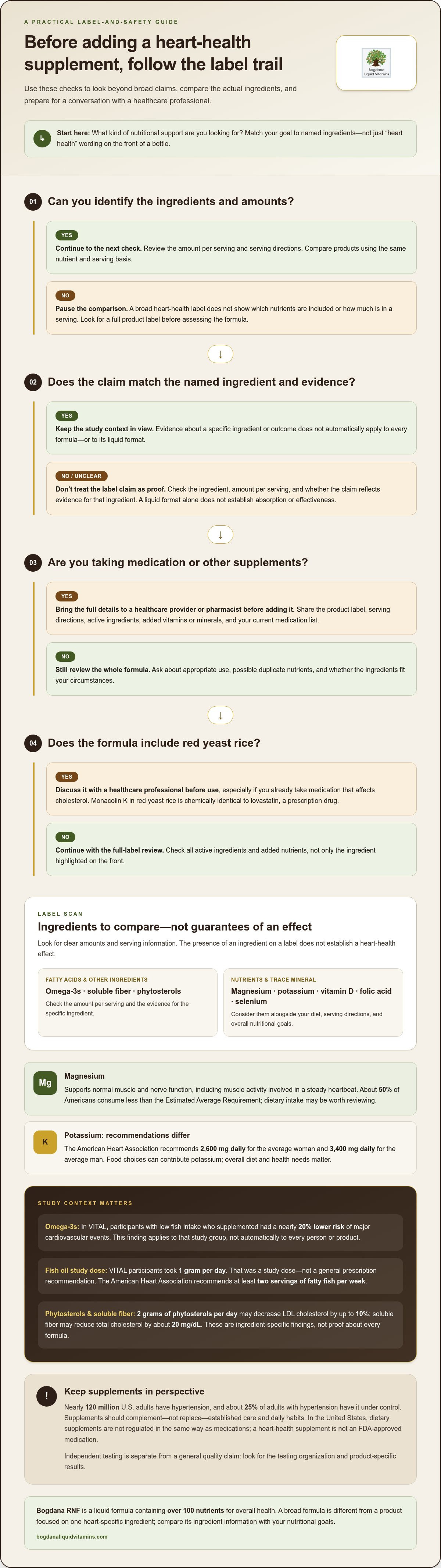
The American Heart Association recommends at least two servings of fatty fish per week, not a universal daily omega-3 supplement dose. In VITAL, participants took 1 gram of fish oil per day; that was a study dose, not a general prescription recommendation. Prescription decisions depend on a person’s health needs and treatment plan.
Magnesium helps support normal muscle and nerve function, including the muscle activity involved in a steady heartbeat. About 50 percent of Americans consume less than the Estimated Average Requirement for magnesium. That makes dietary intake worth reviewing, but a shortfall does not mean magnesium supplements treat high blood pressure or heart disease.
Blood pressure remains a significant concern: nearly 120 million U.S. adults have hypertension, and about 25 percent of adults with hypertension have it under control. These figures reinforce why supplements should complement, not replace, established care and daily habits. A supplement label alone cannot show whether a nutrient is appropriate for an individual.
Potassium is another nutrient to consider alongside magnesium. The American Heart Association recommends 2,600 mg daily for the average woman; the listed recommendation for the average man is 3,400 mg daily. Food choices can contribute potassium, while a person’s overall diet and health needs shape what intake is appropriate.
Omega-3 evidence also requires context. In VITAL, participants with low fish intake who supplemented with omega-3s had a nearly 20 percent lower risk of major cardiovascular events. The finding applies to that study group, not automatically to every person or product. Compare a product’s stated nutrients with your diet, and discuss supplements with a healthcare professional before adding them to your routine.
Supplement safety and consultation with a healthcare provider
Dietary supplements aren’t regulated in the same way as medications. In the United States, a heart-health supplement should not be mistaken for an FDA-approved medication. Independent testing is a separate matter: look for the testing organization and product-specific results rather than relying on a general quality claim.
Liquid supplements and capsules can both provide nutrients, but the format alone doesn’t establish absorption or effectiveness. The ingredient, formulation, amount per serving, and how you take it all matter. Compare labels using the same nutrient and serving basis, then consider which format you can use consistently. Liquid isn’t automatically more effective than a capsule.
Before adding a supplement, share its full label with your healthcare provider or pharmacist. Include the serving directions, active ingredients, and any added vitamins or minerals. Bring your current medication list, too. This helps them review possible interactions and whether the ingredients are appropriate for your circumstances.
Some ingredients require particular care when combined with medications. Monacolin K in red yeast rice is chemically identical to lovastatin, a prescription drug. Discuss red yeast rice with a healthcare professional before use, especially if you already take medication that affects cholesterol.
Use these practical steps:
Write down each supplement and its serving directions.
Record your medications and any recent changes.
Ask about ingredient interactions, duplicate nutrients, and appropriate use.
Keep the product label available so the exact formula can be reviewed.
Once you’ve identified the nutrient support you want, compare the ingredients and serving information in liquid vitamin formulas as part of your decision.
Products marketed for heart health support
Heart-health labels may feature ingredients with different evidence and roles. Check the amounts and study context instead of relying on a broad claim on the front of the label.
Evidence for Heart-Health Support
Research applies to specific ingredients and outcomes, not automatically to every liquid formula. Evidence discussed for omega-3s and cholesterol-related ingredients comes from studies of those ingredients, not proof that a product’s liquid form improves heart health. A useful label review starts with named ingredients, amounts per serving, and whether the product’s claims match the ingredient evidence.
Liquid Omega-3 Benefits and Risks
Liquid fish oil can provide omega-3 fatty acids, but the label should clearly identify the serving and nutrient amounts. The possible benefit depends on the ingredient and the person’s circumstances, while risks can depend on medications and other ingredients in the formula. Review the full product label with a healthcare professional before adding it to a routine.
Heart-Health Supplement Label Ingredients
Look for clear amounts of omega-3s, soluble fiber, or phytosterols, alongside nutrients such as magnesium, potassium, vitamin D, folic acid, and the trace mineral selenium. Their presence on a label doesn’t establish a heart-health effect. Two grams of phytosterols per day may decrease LDL cholesterol by up to 10 percent; soluble fiber may reduce total cholesterol by about 20 mg/dL. Compare the serving directions and claimed outcomes with the evidence for each ingredient.
Bogdana Liquid Vitamins: Bogdana RNF - Rejuvenating Nutritional Formula
Bogdana RNF - Rejuvenating Nutritional Formula is a liquid supplement for people seeking broad nutritional support for overall health. It contains over 100 nutrients, offering a comprehensive approach rather than focusing on one heart-specific ingredient.
That distinction matters. Research on magnesium, potassium, or omega-3s relates to those specific nutrients and does not establish that a broad formula provides the same effects. If you’re considering liquid supplements for heart health support, compare your nutritional goals with the formula’s ingredient information, and discuss supplements with your healthcare provider as part of your overall care.
Bogdana Liquid Vitamins offers liquid formulas for adults and seniors, women and men, as an option for general wellness. Review Bogdana RNF and the available formulas to learn more about the product’s ingredients and features.
Make Your Next Choice With Care
A thoughtful next step is to decide what you want a supplement to add to your routine. Choosing liquid supplements for heart health begins with selecting ingredients that support your nutritional needs and complement your diet, physical activity, and existing care. Consider how it fits with food, movement, and the care you already receive. Keep the product label handy, and discuss it with your healthcare provider if you have questions about using it with your current care.
Bogdana Liquid Vitamins offers liquid formulas for overall wellness, including options for adults and seniors. Review the products and their ingredient information so your choice reflects your needs, not just a claim on the front label.
Small, informed choices can help you build a wellness routine with greater confidence.
Frequently Asked Questions
Can supplements improve heart health?
Some supplements provide nutrients that support normal body functions, but they aren’t a substitute for a balanced diet or medical care. Benefits depend on the ingredient and your nutritional needs. When reviewing a product, compare its nutrient amounts with your usual diet and discuss potential gaps with a healthcare professional.
Do liquid CoQ10 supplements support heart health or blood pressure?
CoQ10 is engaged in cellular energy production, but a liquid format alone doesn’t show that a product supports heart function or blood pressure. Evidence about an ingredient also doesn’t automatically apply to every formula that contains it. If you’re considering CoQ10, bring the product label and your medication list to a healthcare professional for a review.
What are the side effects and medication interactions of liquid heart-health supplements?
Side effects and interactions depend on the ingredients, amounts, and medications involved. For example, monacolin K in red yeast rice is chemically identical to lovastatin, so adding it to a medication routine calls for careful review. Check the full ingredient panel, note any changes after starting a product, and share those details with your pharmacist or healthcare provider.
Who should avoid heart-health supplements or consult a doctor first?
If you take prescription medication or manage a health condition to discuss a new supplement with your healthcare provider. This is especially important for products that combine several nutrients, as an ingredient may overlap with another supplement or medication. Share the exact label and your current routine, including vitamins, minerals, and herbal products to review.


Comments